Quick links:
Tree ||
Bifurcations |
Marx |
Primes |
Intra- |
Whitewater II
Whitewater (2006) - for any multiphonic producing wind instrument + live electronics
[Harmony] Spectral modeling. The live player produces multiphonics and (where playable) the individual pitches which make up the multiphonic.
[Bounded-Improvisation] Whitewater is an open-work, the score defines an Environment and a set of interactions: although an example score of a possible realisation is included (as an appendix) to aid the performer [expand + generalise in chapter on Form?].
Environment:
The focus of the live part is on sustained sounds. Specifically, multiphonics, and whatever single pitches may be extracted from the multiphonic by using the same fingering: for timbral and intonational variation, the player is also allowed to include refingerings of these single pitches. One suggested technique1 is to move smoothly from full multiphonics to single pitches or partial multiphonics, and variations on this.
It is suggested for good practice that the player come to the piece with a repertoire of at least eight multiphonics which vary in density, register, volume, etc., and be practiced in moving between them smoothly. Whitewater makes no use of the fragility inherent in multiphonics, the player is required to be in full control of the timbre, without squeaks or splutters: on those occasions when a multiphonic does not speak, no effort should be made to re-take it as this would breake the piece's flow.
Interactions:
[Form] Constant interplay between repetition and variation leads to form.
- Repetition:
- types:
- Of live multiphonics as objects with space ('whitespace' concept: see below) between them.
- Of single pitches, as objects themselves, as a continuation or pre-emption of a multiphonic:
- As stasis of computer part: complete stasis/oscillation
- level of repetition determines foreground/background-ness (which may be undermined by more perceptually critical issue of the relative volumes of the planes/objects.
- Variation:
- Local (micro-structural):
- Object-oriented: live multiphonic/pitch as single object
- continuum/phrase oriented: computer output forms a phrase (continous sound) of varying duration which moves between levels of variation and stasis (constant or looping/oscillating)
- global (macro-structural)
- density/amount of repetitions
- meta-repetition: how predictable are the sets of repetitions
- Stasis may be:
- the complete stillness of a sustained sound
- the almost stillness of a sustained sound with an inner timbral life of beating, where the constituent parts are not extractable from the whole by perception alone. Forms a single gestalt element.
- The almost stillness of oscillating sounds, where the constituent parts are separate entities within a single complex. Is this still a single gestalt? Not atomic, inner elements have their own identity.
- Different sounds with fixed/predictable repetition.
Form emerges out the interplay between layers, where these layers may be (1)static, (2)in repetitious motion, (3)in goal-directed motion [need diagram, model].
This interplay is partially in the hands of the performer, and partially at the whim of the computer: see
Bounded-Improvisation above [expand].
Quick links:
Tree ||
Whitewater |
Marx |
Primes |
Intra- |
Whitewater II
Bifurcations (2006) - for Clarinet Quartet
[Harmony] To facilitate the narrow clusters and beats-based harmony, before playing, clarinets II & III tune down approximately a quarter-tone. Precise detuning is not too important here because the players will play many microtonal intervals throughout the piece, many of which will have to be 'lipped' into place: exact beat-frequency tuning is a level of precision beyond what is required here.
The first two of Bifurcations' three sections are based on simple pitch processes, the linear contraction of a chord: the third uses multiphonics and focuses more on stasis(?). The first section (bb.0-39) begins with a chord {D, F¼flat , G¼flat, A} (in performance this chord sounds oddly tonal, possibly an unconscious correction by the players) [musical example + audio of start and end chords in progression], and over 39 bars slowly contracts into two clusters, one around G#5, the other around E5. The players are instructed to maximise the beating in this piece, and not to unconsciously tune to each other, the small size of the intervals throughout this movement (approximately one semitone traversed in the space of three minutes) mean that the players' sense of pitch is often in a state of disorientatation by bar 39. The notation of accidentals is in 16th-tones, however in practice the players are advised to aim for a smooth transition across the section, in places where a specific interval is impossible due to the mechanics of the instrument, the player must simply 'make up for it' at the next interval in order to stay true to the general pitch trajectory.
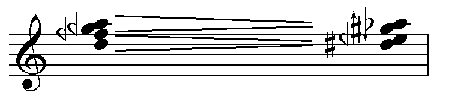
Fig.x Bifurcations first section harmony
The second section (bb.39-60) follows a similar pattern but with two chords in simultaneous motion. The formal concept demands here two perceptually separate objects, this is achieved first by placing the new chords in different registers and using different pitch areas, also through each having a different trajectory: the upper chord contracts while the lower chord crosses over itself. Due to the registral placement of the lower chord, the pitch motion is difficult to perceive, what is heard instead is a constantly altering beat-pattern as the two pitches cross each other within the ambitus of only a semitone.

Fig.x Bifurcations second section harmony
The third section bifurcates into four parts, here achieved with multiphonics.

Fig.x Bifurcations third section multiphonics harmony
[Form] The initial impetus for this piece came from seeing bifurcation diagrams used in chaos theory and non-linear dynamics [diagram].
a bifurcation occurs when a small smooth change made to the parameter values (the bifurcation parameters) of a system causes a sudden 'qualitative' or topological change in its long-term dynamical behaviour.[wikipedia - improve]
The essence of which, transliterated into musical form, is of a single object which splits into two then four, each time upon reaching a critical level of tension – subjectively defined by the composer. As in the scientific definition of the term, the bifurcation points themselves are sudden shatterings of what is otherwise a smooth process of transformation, marking a phase-state shift in the pitch relationships.
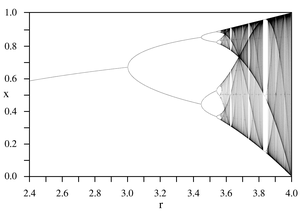
Fig.x Bifurcation diagram